
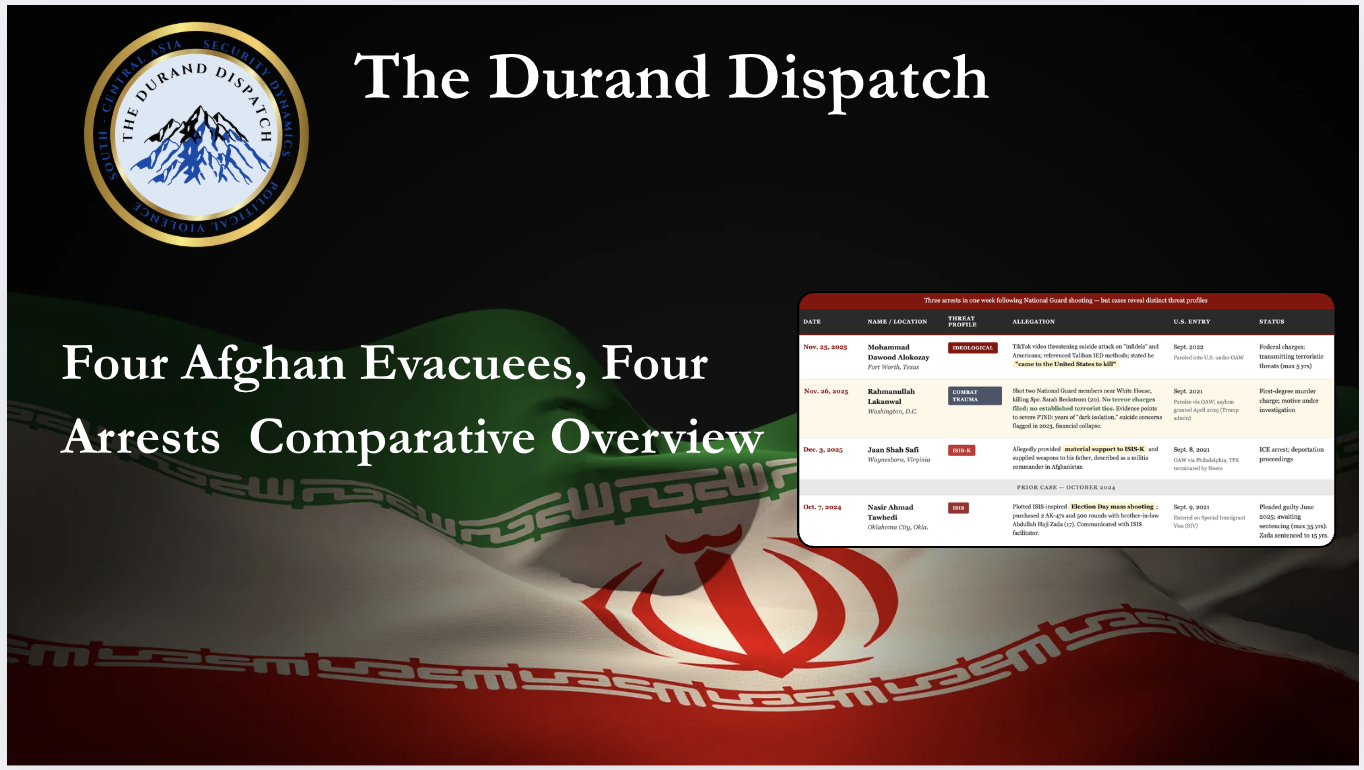
Different Paths to Violence: The Afghan Evacuee Cases Driving Policy
In the ten days following the fatal shooting of a National Guard soldier near the White House, the Trump administration arrested two additional Afghan evacuees on terrorism-related charges, suspended all Afghan immigration processing, and characterized the cases as evidence of systemic vetting failures under the Biden administration. This framing, however, obscures a critical analytical distinction: the shooter at the center of the policy response — a former CIA-backed commando who served eight years in elite counterterrorism units — has no established connection to a terrorist organization. Investigators have filed no terrorism charges. The available evidence instead suggests years of untreated combat trauma that existing support systems failed to address.
While other recent cases of non-state actor violence involving citizens of Afghanistan appear to conform to established patterns of ideological radicalization: explicit allegiance to jihadist organizations, consumption of extremist propaganda, and stated intent to commit violence against perceived enemies of Islam, the Lakanwal case presents a fundamentally different profile — one defined not by ideology but by psychological collapse. Emails obtained by the Associated Press reveal that community advocates had documented his deterioration for years: extended periods of isolation in darkened rooms, an inability to care for his children, erratic cross-country drives. A refugee services organization was contacted in 2023 over concerns that he had become suicidal. Yet no intervention materialized. He passed multiple layers of security vetting across two administrations — his asylum was granted in April 2025 under the Trump administration — but received no adequate mental health support. A 2023 Office of Refugee Resettlement survey found that over half of Afghan evacuees reported mental health challenges; three-quarters had not received professional assistance.
The conflation of these analytically distinct cases carries important policy implications for Afghans. The administration's response, announced on Truth Social as a "permanent pause" on immigration from "Third World Countries", affects thousands of individuals awaiting resettlement, many of whom remain stranded in Pakistan under conditions of considerable precarity, facing both Taliban retribution and Pakistani deportation campaigns. Obaidullah Baheer, who teaches political science at the American University of Afghanistan, characterized the policy as "collective punishment."
To understand why these cases demand distinct analysis, each case is examined in detail — beginning with the shooting that precipitated the policy response.

Comparative Cases
The Attack
On November 26, 2025, two West Virginia National Guard members were shot while patrolling downtown Washington as part of the Trump administration's D.C. Safe and Beautiful Mission. U.S. Air Force Staff Sgt. Andrew Wolfe, 24, and U.S. Army Spec. Sarah Beckstrom, 20, were ambushed at approximately 2:15 p.m. near the White House. Beckstrom died the following day. Wolfe remains in critical condition. The suspect, 29-year-old Rahmanullah Lakanwal, has been charged with first-degree murder. U.S. Attorney Jeanine Pirro stated Lakanwal used a .357 Magnum handgun in what authorities described as a targeted ambush. Other guardsmen returned fire, wounding and apprehending him.
From Khost to the Kandahar Strike Force
Lakanwal hails from Khost province and served in Afghanistan's National Directorate of Security (NDS), the former republic's premier intelligence agency. U.S. officials believe he began working with the CIA around 2011. He was assigned to NDS-03, one of the elite Zero Units that formed the CIA's principal counterterrorism strike forces in Afghanistan. Lt. Gen. Sami Sadat, former commanding general of the Afghan National Special Operations Corps, confirmed to CBS News that Lakanwal served in the 03 unit for eight years. A former senior Afghan general described NDS-03, also known as the Kandahar Strike Force, as "the most active and professional forces, trained and equipped by the CIA. All their operations were conducted under CIA command." Lakanwal was stationed at Firebase Gecko outside Kandahar — a facility occupying the former compound of Taliban supreme leader Mullah Omar. Rolling Stone described these units as "the CIA's secret army, carrying out some of the most dangerous missions of the war targeting Al Qaeda and ISIS leaders." Zero Units operated alongside Navy SEALs, Army Special Forces, Rangers, and Marine Raiders. A viral photograph of what appears to be Lakanwal's Firebase Gecko identification badge has circulated online, though The Durand Dispatch has not independently verified its authenticity.
The Zero Units remain deeply controversial. Human Rights Watch accused them of extrajudicial killings, with some human rights organisations calling them "death squads." One investigation documented at least 452 civilian deaths, including children, in 107 raids. CIA Director John Ratcliffe confirmed Lakanwal worked "with the U.S. Government, including the CIA, as a member of a partner force in Kandahar."
Evacuation and Vetting
In September 2021, Lakanwal entered the United States through Operation Allies Welcome, which processed approximately 78,000 Afghan refugees following the U.S. withdrawal. Zero Unit members often received priority evacuation status as they became high-priority targets for the Taliban. The CIA evacuated an estimated 10,000–12,000 Zero Unit fighters and their families, with Lakanwal undergoing multiple vetting layers. The CIA initially vetted him in 2011 through various databases, including the National Counterterrorism Center, checking for terrorist connections. He was re-vetted in 2021 during Operation Allies Welcome — first at a Middle Eastern processing site, then upon U.S. arrival. "In terms of vetting, nothing came up," a senior U.S. official told CNN. "He was clean on all checks."
Lakanwal applied for asylum in 2024, with his application approved in April 2025 under the Trump administration, though his green card application remained pending. He settled in Bellingham, Washington, a city in Whatcom County that has resettled nearly 400 Afghan refugees through the refugee charity, World Relief Western Washington, since 2021 — with his wife and five children. He briefly worked for Amazon Flex starting in July 2025, delivering packages for approximately one month before becoming inactive.
Deterioration: "Periods of Dark Isolation"
Emails obtained by media outlets reveal a man unraveling over years. Community advocates who worked with Afghan families in Washington state described Lakanwal alternating between extended "dark isolation" and sudden cross-country drives. He could not maintain employment or commit to English courses. The emails document severe dysfunction. Lakanwal spent weeks in his "darkened room, not speaking to anyone, not even his wife or older kids." A community advocate contacted a refugee organization in 2023, fearing he had become suicidal. That same year, the family faced eviction after months of unpaid rent. Family members told authorities Lakanwal suffered from post-traumatic stress disorder stemming from his combat service. Research on Afghan evacuees documents widespread mental health challenges: anguish over family separation, traumatic memories from Afghanistan, and acculturation difficulties. A 2023 Office of Refugee Resettlement survey found over half of Afghan evacuees reported mental health challenges. Three-quarters said they had not received professional help. The community member who shared the emails with investigators said they worried Lakanwal might harm himself. But they saw no indication he would commit violence against others. Before the attack, Lakanwal drove across the country from Washington State to D.C. Investigators have not established a motive.
Lakanwal Shooting a Part of a Broader Pattern? The Other Cases
The administration has framed the Lakanwal shooting as part of a broader pattern, with the Department of Homeland Security characterizing it as a "terror and ambush-style attack" — language that presumes ideological motivation investigators have not established. Within a week of the shooting, two additional Afghan nationals admitted under Operation Allies Welcome were arrested on terror-related charges. Unlike Lakanwal, these cases conform to established patterns of ideological radicalization.
Mohammad Dawood Alokozay was arrested by the FBI's Joint Terrorism Task Force on November 25, 2025 — one day before the D.C. shooting — after posting a TikTok video threatening to conduct a suicide attack on "infidels" and Americans. According to the federal complaint, Alokozay, 30, spoke in Dari about building a bomb in his vehicle, referenced a yellow cooking oil container "favored by the Taliban" for constructing IEDs, and stated he "came to the United States to kill." He told investigators he was "not afraid of deportation or getting killed." Alokozay entered the U.S. as a lawful permanent resident in September 2022 through Operation Allies Welcome. He faces up to five years in federal prison for transmitting terroristic threats.
Jaan Shah Safi was arrested by ICE agents on December 3, 2025, in Waynesboro, Virginia — less than 100 miles from the White House — for allegedly providing material support to Islamic State Khorasan and supplying weapons to his father, described as a militia commander in Afghanistan. Safi entered the U.S. in September, 2021, through Philadelphia. He applied for Temporary Protected Status, but his application was terminated after Secretary Noem ended TPS for Afghans earlier this year.
These arrests follow the October 2024 case of Nasir Ahmad Tawhedi, 27, who pleaded guilty in June 2025 to conspiring to conduct an ISIS-inspired mass shooting on Election Day in Oklahoma. Tawhedi and his teenage brother-in-law, Abdullah Haji Zada, had purchased two AK-47 rifles and 500 rounds of ammunition before FBI agents intervened. Zada was sentenced in November 2025 to fifteen years in federal prison — the statutory maximum. Both entered through Operation Allies Welcome.
The distinction matters. Alokozay, Safi, and Tawhedi demonstrated explicit ideological allegiance to jihadist organizations. Lakanwal has no established connection to any terrorist organization, and investigators have filed no terror charges. The evidence points instead to untreated combat trauma: emails documenting years of deterioration, community advocates flagging suicide concerns, and family members reporting severe PTSD. A June 2025 DOJ Inspector General audit found the FBI conducted Afghan evacuee screening "in accordance with applicable guidance" — but no database query would have flagged untreated PTSD.
Political Fallout and Regional Impact
President Trump announced on Truth Social his administration would "permanently pause immigration from all Third World Countries," "terminate all of the millions of Biden illegal admissions," "remove anyone who is not a net asset to the United States," "end all Federal benefits and subsidies to noncitizens," "denaturalize migrants who undermine domestic tranquility," and "deport any Foreign National who is a public charge, security risk, or non-compatible with Western Civilization."
The U.S. Citizenship and Immigration Services announced it would halt "indefinitely" all immigration processing for Afghan nationals. The decision affects an estimated 260,000 Afghans awaiting U.S. resettlement, many stranded in Pakistan. The announcement sent shockwaves through Afghan refugee communities globally. "I've been in the US for a year as a refugee case and have not yet received a green card, and now I have become very worried," one Afghan in California told Radio Free Europe. "Not only me, but all Afghans here are worried. We are worried that we will be deported or face other problems, because we came here from Afghanistan with great difficulty."
For Afghans in Pakistan, the policy shift represents catastrophe compounded. "We have no future here in Pakistan," Ejaz, a former Afghan Air Force member who served with NATO, told Arab News. "Our only hope was to reach America. As a former soldier, I cannot go back. If I return, I will be targeted and killed by the Taliban. There is no way back for me." He added: "The decision from the US is not fair. I beg them to check our cases carefully. If there is someone who is not right, that is fine, but do not punish the rest of us. Do not abandon us."
Another refugee in Pakistan, identified only as Sahar, said: "Our only hope was America — the promise of safety and the chance to continue our education. That hope was a lifeline. Now, that lifeline has been cut, and we are falling into an abyss. I beg the American government to rethink this. You asked us to stand for modernity and human rights. We did. Now, in our darkest hour, we are being left behind. Saving us is not just a policy decision; it is a moral duty. Do not punish us for a crime we did not commit."
Pakistan has intensified deportations of Afghan refugees in 2025, with nearly 4 million Afghans living there until 2023. The country condemned the D.C. shooting while simultaneously using it to argue that "Afghan territory must not be used for terrorism," referencing its long-standing accusations that the Taliban harbors Pakistani Taliban (TTP) militants. Obaidullah Baheer, who teaches political science at the American University of Afghanistan, called the immigration pause "collective punishment."
The latest U.S. announcement prompted protests by refugees at U.S. State Department facilities in Doha. There was no immediate reaction from Afghanistan's Taliban government, and officials in Kabul did not respond to media requests for comment. A close family member of Lakanwal expressed disbelief: "We were the ones who were targeted by the Taliban in Afghanistan. I cannot believe that he might do this. I don't know what happened. I need your help to know why this happened."
The Risks of Conflating Threat Profiles
This case exposes critical gaps at the intersection of counterterrorism partnerships, mental health infrastructure, and resettlement policy. Zero Unit members like Lakanwal were essential to U.S. counterterrorism operations but often participated in operations with documented civilian casualties. Their evacuation was both a moral imperative — given Taliban retaliation risks — and operationally necessary, as they secured the airport evacuation. However, the case reveals inadequate mental health support systems for Afghan evacuees carrying combat trauma. Community advocates identified Lakanwal's deterioration years before the attack but lacked mechanisms to address severe PTSD in someone cleared through multiple security vettings.
The administration's response, treating Lakanwal's case alongside genuine terrorist plots by Alokozay, Safi, and Tawhedi as evidence of a singular "vetting failure" , conflates distinct threat profiles. Ideological radicalization and untreated combat trauma demand different interventions: enhanced intelligence sharing and post-arrival radicalization detection for the former; functional mental health infrastructure for combat veterans carrying trauma from America's longest war for the latter. Yet the sweeping policy response, halting all Afghan immigration processing, punishes tens of thousands awaiting resettlement, many stranded in precarious conditions.

Trusted by millions. Actually enjoyed by them too.
Morning Brew makes business news something you’ll actually look forward to — which is why over 4 million people read it every day.
Sure, the Brew’s take on the news is witty and sharp. But the games? Addictive. You might come for the crosswords and quizzes, but you’ll leave knowing the stories shaping your career and life.
Try Morning Brew’s newsletter for free — and join millions who keep up with the news because they want to, not because they have to.


