
👉 Access the complete brief and supporting visuals in the members-only edition at DurandDispatch.com or subscribe here

Editor’s Note

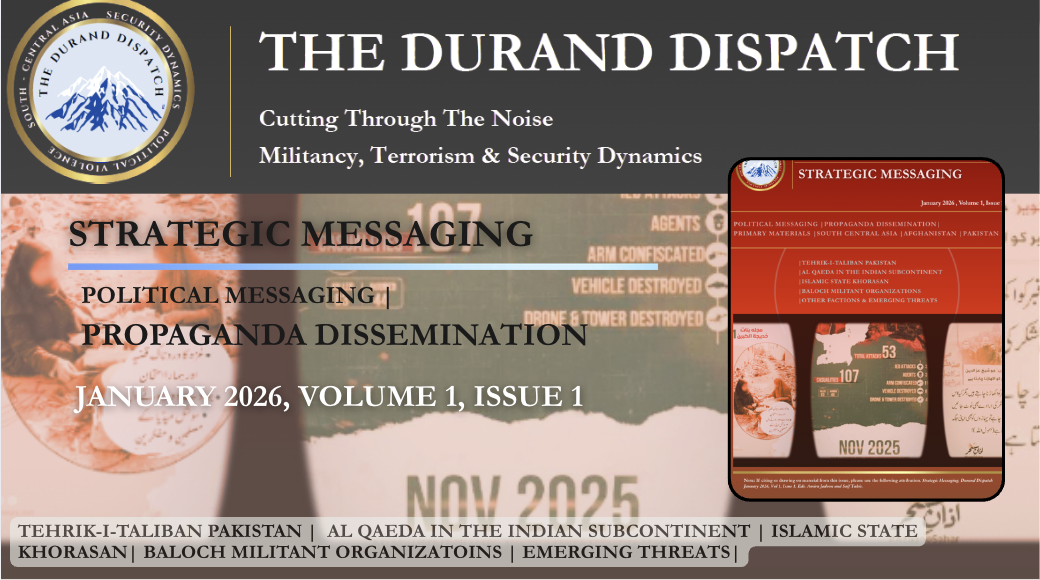
Welcome to the January 2026 issue of the Durand Dispatch: Strategic Messaging, our monthly publication that examines how non-state actors across the Afghanistan–Pakistan region shape perceptions, frame legitimacy, and assert influence through media and narrative construction. This analysis complements our Durand Dispatch: Perspectives Series, which covers a wider range of topics including militancy, Afghanistan-Pakistan relations, and security dynamics across South/Central Asia. Together, the two provide a fuller understanding of how strategic messaging intersects with on-the-ground dynamics.

The closing months of 2025 revealed a militant landscape that is diffuse, adaptive, and increasingly difficult to contain. In November–December, the Tehrik-i-Taliban Pakistan (TTP) continued pushing beyond its Pashtun heartlands into Gilgit-Baltistan, rural Sindh, South Punjab, and Balochistan, demonstrating a willingness to operate inside ethnic, sectarian, and political fault lines the state has historically struggled to manage. At the same time, counterterrorism pressure produced meaningful disruptions—most notably the December disclosure that Islamic State Khorasan Province (ISKP) chief spokesperson and Al-Azaim founder Sultan Aziz Azzam had been arrested in May—yet propaganda adaptation and tactical learning continued across the ecosystem.

This issue of Durand Dispatch maps what matters for 2026: where the violence is diffusing, which factions are fragmenting or aligning, and what new operational capabilities are becoming normalized—including thermal-enabled sniper warfare tied to U.S. weaponry left behind in Afghanistan, evolving suicide-attack dynamics, and the growing use of female bomber symbolism in Baloch mobilization narratives.

We also go beyond incident tallies to unpack the messaging architecture driving recruitment, legitimation, and factional positioning across Pakistan’s militant ecosystem. This issue examines TTP’s Mujallah Banaat (December edition), a women-focused magazine that frames violence through religious obligation while foregrounding Gaza, family values, and alleged state atrocities in the tribal districts, signaling a continued effort to normalize militancy within domestic moral and social life. We also analyse ISKP’s Al-Azaim output, including a Pashto-language ideological treatise declaring democracy a rival religion incompatible with Islam, rejecting electoral politics across Afghanistan and Pakistan. Beyond these deep dives, the issue tracks how jihadist and separatist groups are adapting propaganda delivery through decentralized platforms, exploiting local grievances, and borrowing visual and narrative cues across factions—offering early indicators of where recruitment pipelines, ideological convergence, and future violence are most likely to emerge in 2026.

Full Report Available

The full issue—along with our archive—offers in-depth analysis of group-level propaganda, tactical shifts, and recruitment strategies, drawing on primary sources including militant publications, videos, and social media. Thank you for your continued support of Durand Dispatch.

👉 Catch up on our Durand Dispatch Perspectives Collection.

logo

Subscribe to our premium Strategic Messaging content to read the full briefing:

---------------------------------------------------------------------

Upgrade

Gain access to:

  • In-depth Monthly Analyses - Detailed breakdowns of militant propaganda and narrative trends across South and Central Asia.
  • Exclusive Visual Summaries - Infographics and dashboards that translate complex messaging into clear, actionable insights.
  • Implications & Overlaps - Analysis that connects dots across groups, platforms, and regions—showing how narratives converge or diverge.
  • Archival Access - A searchable library of past issues and visual summaries, available only to subscribers.

Reply

Avatar

or to participate