
In partnership with

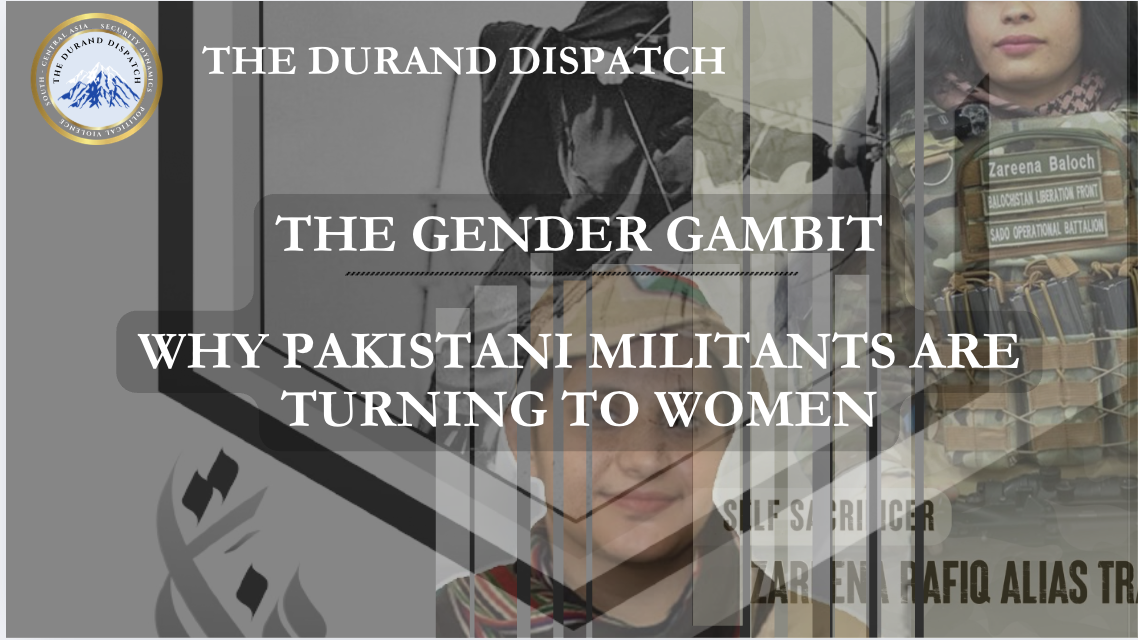
BLF Claim (source: Telegram)

Citation: Amira Jadoon, The Gender The Gender Gambit: Why Pakistani Militants Are Turning to Women, Durand Dispatch, December 2025

The Gender Gambit: Why Pakistani Militants Are Turning to Women

When a suicide bomber detonated explosives at the entrance gate of a Frontier Corps base in Nokundi, November 30, Chaghi district, Balochistan, it was more than another deadly attack in Pakistan's restive southwest. The fierce ninety-minute gunbattle that followed, in an area sharing borders with Afghanistan and Iran near major copper-and-gold projects, represented the latest instance of the Balochistan Liberation Front (BLF) deploying a female suicide bomber. According to BLF’s post-attack claim, the attacker was “Zareena Rafiq, alias Turang (or Tarang) Mahoo,” a woman whom the group identified as a “self-sacrificer” (fidayeen).

BLF released a photograph of Zareen, claiming she detonated a 500-kilogram vehicle-borne improvised explosive device (VBIED) at the main gate, creating a large blast crater and destroying guard posts — an act meant to breach the compound’s barrier and pave the way for armed militants to storm the base.  If confirmed by security agencies, this would mark the first publicly acknowledged use of a female suicide operative by BLF, underscoring a shift in the group’s operational tactics and gendered recruitment practices. (Some media reports attribute the attack to the Balochistan Liberation Army (BLA); responsibility remains contested.)

Her involvement in the attack is notable not merely for its tactical execution, but because it exemplifies a shift in how militant organizations across Pakistan are rethinking the role of women in their operations, a trend with implications far beyond Balochistan's borders.The intersection of terrorism and technology, from early adoption of encrypted communications by violent non-state actors to social media exploitation, has long been a policy concern. Yet the June 2025 publication of Voice of Khurasan Issue 46 marks a qualitatively new development: the explicit theological elevation of artificial intelligence literacy from tactical consideration to religious imperative.

DD infographic

The Durand Dispatch - Visualization DFAT Country Information Report Pakistan, 30 April 2025 (20 x 25 in).pdf

Download infographic

579.82 KBPDF File

Why Separatists and Jihadists Are Both Turning to Women

The BLF's deployment of Zareena fits a pattern that research on violent organizations consistently identifies: ethnonational movements like the Baloch Liberation Army are particularly inclined to employ women as attackers. The reasons are coldly pragmatic. Female fighters allow militant groups to evade security measures, expand their scope of targets, and incorporate an element of surprise due to the unexpected profile of the perpetrator. 

Studies demonstrate that female recruits often garner high levels of publicity and can be particularly deadly in societies like Pakistan where women's participation in public life is traditionally limited. The data bears this out. Research analyzing suicide bombings shows that attacks in environments where women were relatively excluded from public life disproportionately killed more victims and garnered more media coverage. The tactical impact of female operatives hinges on prevailing gender dynamics—they confer greater reputational and lethal benefits for groups in rigidly gender-exclusive environments. For groups like the BLA, engaging women can also strengthen bonds with civilian communities and amplify the credibility of their objectives.

Zareena's attack follows an accelerating trajectory of Baloch militants turning to women recruits. In April 2022, Shari Baloch, a mother of two, conducted a suicide attack at the University of Karachi's Confucius Institute. A month later, Noor Jahan Baloch, allegedly linked to the BLA's Majeed Brigade, was arrested in Turbat for reportedly planning a suicide attack. By June 2023, the BLA struck again with another female suicide attacker targeting paramilitary troops. These are no longer aberrations—they represent a calculated strategic shift.

But what makes the Nokundi attack particularly significant is that the BLF is not alone in this evolution. Across Pakistan, militant organizations with fundamentally different ideologies and objectives are simultaneously discovering an 'untapped female operative market.  Another notable example comes from an unlikely source: Tehrik-i-Taliban Pakistan (TTP), the religious-motivated militant group that has traditionally restricted women to non-combat roles.

The Jihadist Evolution: Tehrik-i-Taliban Pakistan’s (TTP) Calculated Pivot

In August 2017, six years before Zareena's attack in Nokundi, TTP released something unprecedented in its decade-long history: Sunnat-e-Khaula, a magazine specifically targeting Pakistani women. The timing was revealing. TTP was facing existential threats—intensified counterterrorism operations, leadership losses, and fierce competition from Islamic State Khorasan Province (ISKP) for recruits and relevance. The magazine featured direct calls for women to participate in jihad, to potentially abandon personal relationships and professional achievements for the cause, and even included specific instructions for "planning martyrdom operations" with targets including "men, women and institutions." By 2023, after TTP had reconsolidated under new leadership and gained strength following the Afghan Taliban's takeover of Afghanistan, the group launched new women's magazines: Khawateen ka Jihad (Women's Jihad) and Banat-e-Khadeejatul Kubra (Daughters of Khadijah). But the messaging had transformed. Rather than direct calls for violent participation, these publications emphasized ideological indoctrination, community influence, and social media activism. Textual analysis reveals a striking evolution: the 2023-2024 issues demonstrated balanced prosocial messaging, reinforcing unity, duty, and religious devotion, with significantly reduced conflict rhetoric. The July 2023 magazine focused on anti-feminist narratives similar to those propagated by Western extreme right-wing groups, framing women's traditional roles as mothers and wives as a mechanism to counter threats from "liberals." Yet even while reinforcing conservative gender roles, the magazine subtly called upon women to "rise up and migrate to the lands of jihad"—a carefully calibrated message that positions women as ideological guardians rather than front-line combatants, at least for now.

What the Parallel Evolution Reveals

The simultaneous evolution of the Balochi militants and TTP's approaches to women—despite their vastly different ideologies—reveals something crucial about contemporary militancy in Pakistan. Rather than being purely ideologically-driven decisions about women's roles, they represent strategic adaptations to organizational circumstances.

Research demonstrates that militant groups' gender-based recruitment strategies are fluid over time, modulating between crisis recruitment and strategic legitimacy-building. During periods of weakness, groups may emphasize grievance-based narratives and direct recruitment appeals. During periods of strength, they are likely to focus on long-term ideological cultivation and community influence. Baloch militants sustained use of female suicide bombers reflects a movement confident in its ethnonational narrative and territorial ambitions. Similarly, TTP's shift from desperate crisis appeals in 2017 to sophisticated ideological messaging by 2023 reflects its organizational recovery and attempts to rebrand as a legitimate armed political opposition.

This pattern extends beyond Pakistan's borders. Between 2014 and 2019, researchers documented militants linked to Islamic State across Indonesia, Malaysia, and the Philippines, with women playing increasingly active roles. Bangladesh, for example, witnessed one of its first female suicide bomber in December 2016. The Islamic State attracted unprecedented levels of female support globally, with women playing increasingly active roles in fundraising, recruitment, governance, and combat operations—particularly as the group faced territorial losses.

The common thread is pragmatism. When Boko Haram in Nigeria faced intensified military pressure, over half its suicide bombers between 2011 and 2017 were female. When groups control territory and seek to deepen community ties, they engage women as ideological ambassadors and social enforcers. When groups face recruitment crises, they actively court female participation in operational roles. Organizational imperatives—survival, competition, legitimacy-seeking—override ideological commitments regardless of whether groups are motivated by religious, ethno-nationalist, or political extremism.

The Nokundi Attack in Context: What Pakistan's Security Apparatus Is Missing

The prolonged gunbattle in Nokundi that began with Zareena's suicide blast should force a fundamental reassessment of Pakistan's counterterrorism approach. It represents a systematic evolution in how militant organizations operate—one is a critical blind spot. The significance of women's involvement is often underappreciated or overlooked due to deeply ingrained societal stereotypes. If women's involvement is viewed as gender atypical, those actively engaged within violent armed groups can fall through the cracks, resulting in gender-blind counterterrorism. Security forces conditioned to view women primarily as victims or non-combatants create exploitable vulnerabilities.

What both Baloch Militants and TTP cases reveal about the drivers of women's recruitment:

  • Personal and ideological motivations matter, but so do structural factors. Research demonstrates that higher unemployment among women significantly increases the likelihood that violent organizations will recruit female combatants. Gender inequalities and political marginalization create conditions where militant groups can position themselves as offering greater agency, status, or resources than mainstream society provides. Pakistan's restrictive social environment paradoxically makes female operatives both more valuable tactically and more available for recruitment.

  • Organizational attributes shape recruitment patterns. Older groups that control territory are more likely to recruit female combatants—they can provide women opportunities for engagement that younger, transient organizations cannot. 

  • Propaganda evolution serves as an early warning system. Understanding how groups adapt their gender-oriented messaging in response to changing strategic conditions can provide intelligence about organizational health, strategic priorities, and recruitment drives. 

Beyond Nokundi: The Dangerous New Normal

Zareena's attack represents a part of an accelerating pattern of female suicide bombers deployed by the BLF—a trend that becomes alarming when placed alongside similar developments across Pakistan's militant landscape. The convergent evolution of Baloch militants’ operational deployment of women and TTP's propaganda campaigns targeting female audiences reveals a fundamental reality: Pakistani militant organizations, regardless of ideology, have recognized women as strategic assets. They have overcome doctrinal hesitations, cultural barriers, and organizational inertia because the benefits—tactical surprise, expanded recruitment pools, community penetration, and media impact—are too significant to ignore.

TTP's evolution from desperate crisis appeals in 2017 to sophisticated ideological messaging by 2023 reflects organizational recovery and attempts at political legitimation. Both trajectories point toward sustained, strategic engagement with female populations rather than temporary expedients. The current approach—treating women's involvement in militancy as exceptional, viewing female operatives as either victims or aberrations, and maintaining gender-blind counterterrorism frameworks—is not merely inadequate. It creates exploitable vulnerabilities that groups like the BLA and TTP are systematically leveraging.

The path forward requires acknowledging an uncomfortable truth: women's participation in Pakistani militancy is no longer emerging—it has emerged.  Pakistan's counterterrorism strategies must evolve accordingly. This means incorporating gender analysis into intelligence gathering, threat assessment, and operational planning. 

Further reading:

Become An AI Expert In Just 5 Minutes

If you’re a decision maker at your company, you need to be on the bleeding edge of, well, everything. But before you go signing up for seminars, conferences, lunch ‘n learns, and all that jazz, just know there’s a far better (and simpler) way: Subscribing to The Deep View.

This daily newsletter condenses everything you need to know about the latest and greatest AI developments into a 5-minute read. Squeeze it into your morning coffee break and before you know it, you’ll be an expert too.

Subscribe right here. It’s totally free, wildly informative, and trusted by 600,000+ readers at Google, Meta, Microsoft, and beyond.

Reply

or to participate