
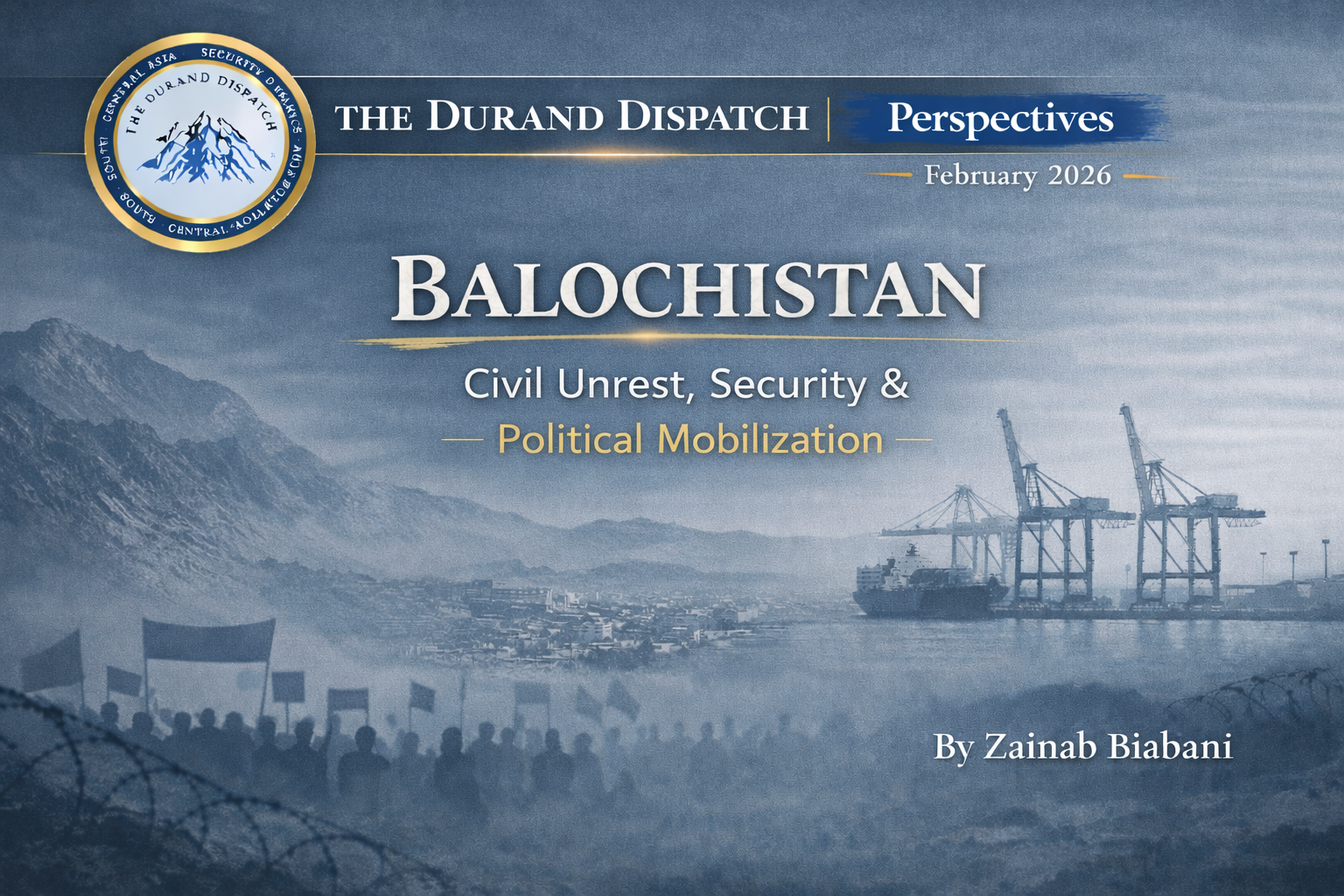
Balochistan has long been shaped by the interaction of governance gaps, security operations, and civil mobilization, which together have produced recurrent patterns of unrest. Over time, longstanding grievances around security practices, civic freedoms, and accountability have become tightly intertwined, creating a conflict environment driven as much by governance tensions as by security dynamics. Developments between October 2025 and January 2026 do not represent a break with this trajectory; instead, they highlight how deeply it is embedded in the province’s political landscape, even as civil mobilization expands and public scrutiny of state institutions intensifies. During this period, a marked escalation in militant activity, including one of the largest insurgent operations in recent years, underscored the acute security challenges facing both the state and affected communities.

At the same time, the period offered glimpses of legislative and institutional movement that point to Balochistan’s capacity for negotiated change. The passage of the Child Marriages Restraint Act by the provincial assembly signalled a willingness to confront pressing social issues through lawmaking, while sustained debates over judicial independence, governance reform, and the province’s economic trajectory — including its role as a corridor for major international investment — indicate that some channels for addressing underlying grievances remain open. Taken together, these developments suggest a landscape that is undeniably fraught, but not static: one in which contestation, reform efforts, and civic engagement continue to shape possibilities for a more accountable and responsive order.

Between Security and Community

Civilian harm is an inherent risk in counterterrorism operations, and in Balochistan, such incidents have continued to act as a major catalyst for unrest. On October 18, air and drone strikes in the Khuzdar district reportedly killed civilians, including women and children, while curfews left families without access to food, water and medical care. The Human Rights Council of Balochistan reported that the operation followed clashes between Baloch fighters and state forces and was accompanied by raids, roadblocks and communication blackouts.

Civilian casualties continued to shape public discourse in the months that followed. In early January 5, 14-year-old Raahi Assa was killed in an incident attributed by the Balochistan human rights organization, the Baloch Yakjehti Committee (BYC), to state-backed armed groups. Later that month, the BLA launched Operation Herof 2.0, a coordinated offensive across at least nine districts in which militants stormed banks, schools, markets, police stations and security installations in one of the largest insurgent operations in recent years. In response, the military initiated a weeklong campaign, Operation Radd-ul-Fitna-1, which concluded on February 5 with 216 militants reportedly killed. According to the ISPR, 30 + civilians, including women and children, were killed by militants during the BLA’s attacks, while 22 security personnel also lost their lives. The scale of the BLA’s offensive, which the group described as a continuation of its August 2024 “Black Storm” campaign, and the state’s subsequent counter-operation reflect a significant intensification of the security environment compared to earlier in the reporting period.

The escalation should be understood within a broader statistical context. Pakistan recorded escalating militant attacks in 2025 and into 2026, with militant groups increasingly shifting from hit-and-run strikes to high-impact, coordinated assaults targeting economic infrastructure and state symbols. Widely reported figures underscore the evolving nature of the threat and the significant security burden borne by both state forces and civilian communities in the province.

In response to reports of civilian harm during military operations, several stakeholders have raised concerns about the humanitarian impact. Reports of the use of force resulting in civilian harm have been criticized, especially where children are among those affected, alongside other restrictive practices reported in connection with military operations, including reported restrictions on movement, communications, and access to basic services. A recurring theme is the demand for accountability, with the Human Rights Commission of Pakistan (HRCP) and other observers calling for independent investigations and access for journalists and observers to verify events. A more explicitly political framing is introduced by prominent Baloch activist Sammi Deen Baloch and the BYC, whose statement characterises the situation as evidence of systemic grievances, restricted access to justice, and the targeting of dissent—particularly women activists.

The security environment in Balochistan also carries important economic dimensions. The China-Pakistan Economic Corridor (CPEC), a flagship component of China's Belt and Road Initiative, has major infrastructure projects concentrated in the province, including the strategically important Gwadar port. Militant targeting of CPEC-related infrastructure and personnel has raised concerns among international investors, contributing to the August 2025 U.S. designation of the BLA as a Foreign Terrorist Organization, building on its prior 2019 designation as a Specially Designated Global Terrorist entity. The interplay between insurgent violence, economic development, and international investment adds a further layer of complexity to an already fraught governance landscape.

These developments formed part of a broader pattern in which the fallout from security operations increasingly intersected with wider concerns about disappearances, legal proceedings and governance.The Security Dilemma

Expanded detention powers and the continued use of extra-legal measures since 2025 have raised concerns that enforced disappearances are becoming a persistent feature of the security landscape in the province. Recent reporting suggests a widening scope of those affected. Multiple sources note a recent rise in enforced disappearances of Baloch women, a development the Baloch Yakjehti Committee (BYC) described as a “deeply alarming escalation and a grave violation of human dignity.” Nearly a year after the arrest and detention of prominent BYC campaigner Mahrang Baloch in March 2025, families staged a sit-in protest on January 24, 2026 after police reportedly refused to register complaints regarding the disappearance of six Baloch women, underscoring growing frustration among families seeking accountability.

The reported refusal to formally document cases highlights the barriers families face in pursuing justice and has reinforced a growing reliance on public advocacy and activism to raise awareness and seek information—a pattern noted byAmnesty International, who found that families of the disappeared are often forced into public campaigning due to limited legal recourse. In response to this, the BYC has urged individuals to document cases of enforced disappearances via social media or directly through the organisation in an effort to ensure cases are recorded and accountability pursued. This pattern of public advocacy was further illustrated in early January, when families blocked a stretch of the CPEC highway at Tejaban Karki in Kech district for multiple days, demanding the recovery of disappeared family members—demonstrating the intersection of disappearances, protest mobilization and strategic infrastructure that has come to define the province’s unrest.

Other legal developments have further added to concerns about the treatment of activists and critics. In November 2025, a coalition of international legal and human rights organizations, including the International Commission of Jurists (ICJ), raised alarm over what it calls the judicial harassment of Pakistani human rights lawyers Imaan Zainab Mazari-Hazir and Hadi Ali Chattha. On January 24, 2026, a sessions court sentenced the couple to a combined 17 years’ imprisonment under Pakistan’s Prevention of Electronic Crimes Act (PECA), with fines totalling Rs. 36 million. The couple has since filed appeals before the Islamabad High Court, seeking suspension of their sentences. The conviction was condemned by UN human rights experts, the ICJ, and Front Line Defenders, citing Pakistan’s obligations under international law and constitutional protections for free expression.

The government has characterized BYC's activities as a recruitment pipeline for militant organizations, with the Counter Terrorism Department presenting evidence it says links BYC activism to subsequent involvement with proscribed groups — an allegation the BYC categorically rejects as politically motivated. The BYC, in turn, has accused the CTD of manipulating judicial processes to silence its leadership, alleging that courts were "rushing to frame charges on incomplete documents," an action it said "blatantly violates judicial procedure." These tensions have played out in specific cases. In December 2025, Mahrang Baloch was acquitted in Karachi of charges filed in October 2024 relating to terrorism, sedition and public mischief, after the court found no material that could lead to conviction. She nevertheless remains detained in Quetta due to additional pending cases following her arrest in March 2025, prompting ongoing questions about due process and the use of overlapping charges to prolong detention. Amid her detention, Mahrang Baloch called on Baloch youth to prioritise education alongside their activism, arguing that academic achievement can strengthen national awareness and safeguard Baloch identity: "A nation survives not by force but through determination.”

During this period, protest participation also reflected growing concern about the reach of the executive branch into the judicial system. In late November 2025, lawyers across Balochistan, particularly in Quetta, protested the 26th and 27th Amendments. The 26th Amendment, passed in October 2024, restructured judicial appointments and created constitutional benches within the Supreme Court, while the 27th Amendment, passed in November 2025, went further — establishing a Federal Constitutional Court, granting lifetime immunity to the president and senior military figures, and creating the role of Chief of Defence Forces. Led by senior lawyer Ali Ahmad Kurd, the Quetta Bar Association argued that the amendments "not only violate the basic principles of the Constitution but also weaken its very essence." Former judges and senior lawyers subsequently urged the Chief Justice to convene a full court meeting on the proposed legislation. The ICJ called the 26th Amendment a blow to judicial independence, warning that the reforms concentrate influence in bodies subject to considerable executive input, potentially limiting the judiciary's ability to hold the government accountable. The ICJ was critical of the 27th Amendment, warning that it undermined the rule of law, a concern echoed by the UN High Commissioner for Human Rights, who warned that the amendments undermine judicial independence.

Amid these tensions, a notable legislative development offered a counterpoint to the province’s governance challenges. In November 2025, the Balochistan Assembly passed the Child Marriages Restraint Act 2025, setting 18 as the legal age for marriage for both males and females and introducing criminal penalties for those who facilitate child marriages—repealing the colonial-era 1929 law that had set the minimum marriage age for girls at 14. The legislation was lauded by UNICEF and child rights organisations, though its passage was contested, with opposition lawmakers arguing it contravened Islamic teachings. The law’s enactment, despite political resistance, reflects a degree of provincial legislative capacity on social reform even as the broader security and political environment remains deeply contested.

Converging Pressures: Security, Governance and the Trajectory of Unrest

Developments between October 2025 and January 2026 reinforce patterns that have been evident throughout the year and beyond. Reports of civilian harm linked to security operations, legal proceedings against activists and the broadening of protest participation have increasingly overlapped, contributing to a cycle of mobilisation and public distrust. Rather than isolated incidents, these dynamics point to deeper governance tensions in which security practices, legal mechanisms and civil resistance continue to shape one another in ways that have become difficult to disentangle.

At the same time, the period underscores that Balochistan’s unrest is unfolding within a wider political and institutional context.The BLA's Operation Herof 2.0 and the state's Operation Radd-ul-Fitna-1 at the close of this period illustrate the escalatory trajectory of the security situation, while recent sentencing of human rights lawyers signals a tightening of the legal environment for critics and rights defenders. The persistent intensity of protest mobilisation, particularly by the BYC, suggests that without credible accountability, transparent legal processes and meaningful institutional reform, these dynamics are unlikely to ease. The passage of the Child Marriages Restraint Act demonstrates that the provincial assembly retains the capacity for legislative reform on pressing social issues; whether similar political will can be directed toward the structural grievances fuelling the broader crisis remains an open question.

Discover more of The Durand Dispatch Perspectives

Reply

Avatar

or to participate

Keep Reading