
This website uses cookies

Read our Privacy policy and Terms of use for more information.

In partnership with

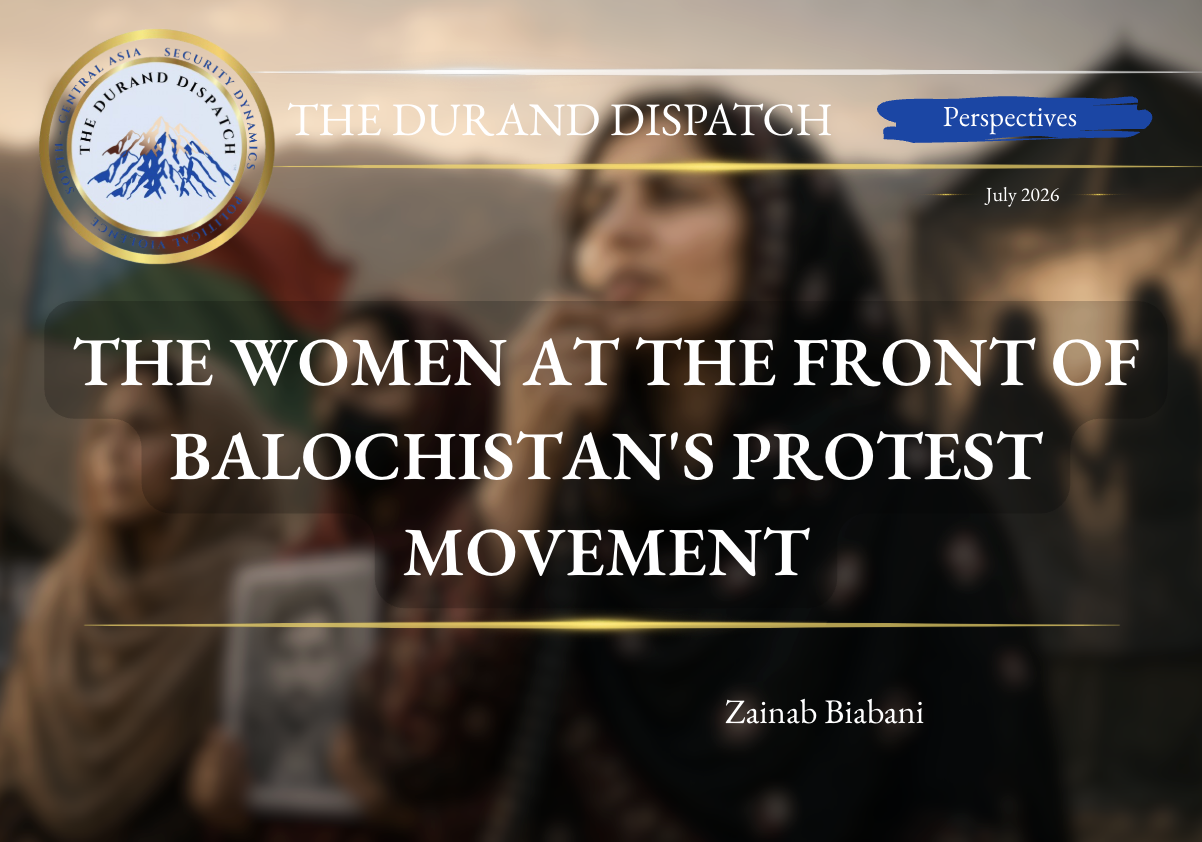
The Women at the Front of Balochistan's Protest Movement

The latest phase of Balochistan’s civic protest movement shows a campaign increasingly carried by women, even as those women become more visible targets of state pressure. Without credible investigations, due process, and political space for peaceful advocacy, coercive responses risk strengthening the very civic infrastructure they are meant to contain, turning documentation, detention, and international scrutiny into a self-sustaining cycle of mobilization.

Over the past two years, the most visible figures in Balochistan's civic protest movement are increasingly women,  leading long marches and sit-ins, speaking on behalf of families with missing members, and occupying space in courtrooms, press clubs and international forums. Dr. Mahrang Baloch, Sabiha Baloch, Sammi Deen Baloch and Fauzia Baloch, all associated with the Baloch Yakjehti Committee’s (BYC) leadership, are among the most prominent, but the pattern runs well beyond a singular name.  The BYC (“Yakhjeti” referring to solidarity and unity) is a human rights movement protesting state abuses in Balochistan. The movement was formed in 2020, originally as the Bramsh Yakjehti Committee, in response to the killing of Malik Naz in Dannok village, Turbat, on May 26, 2020, with the incident triggering widespread protests. Following its emergence, the BYC movement came to be associated most prominently with Dr. Baloch’s leadership, though Pakistani state actors have often framed it as being linked to separatist militants and criminal smuggling networks.

Over the spring of 2026, a second pattern emerged. In the accounts compiled by Baloch rights groups, women and their relatives appear not only as organizers, but with growing frequency, as the people being detained. Among them Khadija Baloch, a nursing student whose reported disappearance prompted a month-long sit-in, and Gul Bank, reportedly taken in Kech. In late June the two trends converged, when an anti-terrorism court sentenced Dr. Mahrang Baloch and a fellow organizer to life imprisonment over the death of a paramilitary soldier during a 2025 protest in Gwadar. Taken together, the movement’s leadership patterns and the state’s targeting of its key figures offer a clearer lens through which to understand its evolution.

Dr. Mahrang Baloch: The Public Face of the Movement

Dr. Mahrang Baloch had been held since March 2025, when she was arrested in the early hours of 22 March 2025 while participating in a peaceful sit-in protest in Quetta, Balochistan.  In April 2026, she challenged the rejection of her bail before Pakistan’s Supreme Court through her lawyer, Jibran Nasir, after the Balochistan High Court denied her bail application on February 23, 2026.

The June verdict superseded those bail proceedings. On June 22, a Quetta anti-terrorism court convicted Dr. Mahrang Baloch and Sibghatullah Shah, both associated with BYC leadership, in a case arising from the killing of Frontier Corps personnel Shabbir Baloch during the 2024 Baloch Raji Machi in Gwadar. The court found Dr. Baloch and Shah guilty of murder and terrorism-related offences, sentencing each to two concurrent life terms and imposing financial penalties, including Rs200,000 in compensation to the victim’s heirs and a Rs200,000 fine under the Anti-Terrorism Act.

The provincial government framed the outcome as justice, with Balochistan's chief minister describing the verdict as a “demonstration of the rule of law and justice,”  and a government spokesman stating that the prosecution rested on “undeniable evidence” and was not politically motivated. Human rights organizations, among them Front Line Defenders, described the proceedings differently, citing concerns about due process and the criminalization of peaceful advocacy. Dr. Mahrang Baloch denies all charges.

Her more than year-long detention in custody already drew scrutiny before the verdict. Dr. Baloch has been detained since March 2025, including at Hudda Jail in Quetta, where rights groups reported concerns about jail-based proceedings and restricted transparency. Amnesty International reported that she developed a severe spinal condition over roughly six months during which, it said, she was denied adequate care. She was moved to a hospital only in February 2026 once her condition worsened, and without the knowledge of her family or lawyers. Her family has pressed for regular access and adequate medical care, which they say have been restricted. In a written interview before sentencing, Dr. Baloch described students, journalists, and human rights activists as routinely silenced through detention and fabricated cases, and said that more than fifty cases had been filed against her and other BYC leaders across Balochistan.

That international attention sharpened in early May, when the UN Committee against Torture adopted its concluding observations on Pakistan. The Committee urged Pakistan to protect human rights defenders, activists, journalists, lawyers, political opponents and protesters from repression and reprisals, and recommended that the state review the cases of those allegedly detained or imprisoned on political grounds or in retaliation for their work. It specifically referred not only to former Prime Minister Imran Khan, but also to Bushra Bibi, Idris Khattak, Ali Wazir, and Dr. Mahrang Baloch. The BYC welcomed the findings and, in its own reading, presented them as validating concerns about enforced disappearances, arbitrary arrests, torture, intimidation, and reprisals against critics of the state.

Pakistan's delegation, for its part, reaffirmed its commitment to the prohibition of torture and pointed to the 2022 Torture and Custodial Death Act and a federal investigative mechanism; the Committee acknowledged the legislation while noting that implementation lagged. Rather than fully engaging the broader allegations of systemic abuse, however, Pakistani authorities have often responded by challenging the credibility of the groups raising them. The BYC has rejected any ‘proxy’ labels and called for an independent inquiry into the allegations. The dispute, in other words, remains contested on the record rather than settled

Two other women have carried the movement's case into formal forums. Dr. Sabiha Baloc, a vocal human rights activist and member of BYC leadership, took the BYC's concerns to the UN Human Rights Council and issued a series of statements through May. Sammi Deen Baloch, the General Secretary of Voice for Baloch Missing Persons and BYC leadership member, publicly argued that the state was working to build a negative narrative around the committee in order to weaken it. Together they have kept the movement visible in venues where Islamabad is sensitive to scrutiny. UN experts have noted that reprisals against BYC members' families and lawyers may be linked to the group's engagement with UN mechanisms, and Mary Lawlor, the UN Special Rapporteur on human rights defenders, has separately raised concern over harassment of Sabiha Baloch and her family specifically. Nonetheless, the committee has itself publicly foregrounded the role of women in the movement.

Increasingly, Women were also the Targets

The Durand Dispatch's earlier analysis noted that women and children were not then the principal subjects of the cases reported by Baloch rights groups. According to those groups, that began to change from February 2026 onward. Several cases over the Spring placed women and their families at the center of the same enforced-disappearance accounts the movement exists to document, a shift worth tracking carefully, since it rests on the groups' own reporting rather than on independently audited figures.

The clearest example was Khadija Baloch, a nursing student at Bolan Medical College in Quetta, reportedly detained in April 2026 without a clear charge. Her case prompted students and family to begin a sit-in at the Bolan Medical Complex that continued for 28 days before ending with a press conference — one of the more prolonged examples of protest within this period.

Other reports followed a similar shape. Baloch outlets reported that a woman, Gul Bank, was taken in Kech in late April, one of several such accounts that month; families said some of the women were later recharacterized by authorities as formally arrested, a framing the families disputed. In Karachi, BYC organizer Fauzia Baloch was reported detained with members of her family at the Karachi Press Club while protesting the disappearance of her brother, Dad Shah Baloch.

The Machinery the Movement Sustains

What gives these individual cases weight is the civic infrastructure built up around them. Much of the movement's civic apparatus functions, in effect, as a standing system for documenting disappearance. The Voice for Baloch Missing Persons camp outside the Quetta Press Club passed its 6,147th day in April. Around the same time the BYC said it had submitted documentation of more than 1,250 cases of enforced disappearance, covering 2025 into early 2026, to the provincial government. These figures originate with the groups themselves and have not been independently verified, but the scale of the documentation effort is itself part of the story.

The movement also marks its own calendar. To mark one year since the detention of Dr. Mahrang Baloch and four fellow leaders, the BYC ran a month-long awareness campaign from 20 February to 20 March 2026, urging supporters to publish, petition lawmakers and submit documentation to UN human rights bodies. Much of that work falls to relatives. Dr. Mahrang Baloch's sister, Nadia Baloch, who trained as a lawyer and has said her sister's release is her first case, has taken a public role in pressing for access — holding press conferences, at least one of which the family said police obstructed outside the Quetta Press Club.

A security approach intended to suppress dissent has, over time, appeared to produce a more durable and organized civic opposition rather than dissolving it, one whose camps, sit-ins, legal petitions and international engagement form a self-sustaining system. The reported turn toward detaining women, often described as a threshold the state had previously been reluctant to cross, has, if anything, widened the movement's base and raised its profile abroad, precisely because women had become some of its most effective public representatives.

By Early Summer

By early summer 2026, the Mahrang Baloch case had come to dominate the movement’s public profile. The June verdict drew protest calls from the BYC and statements from international rights organizations, while Pakistani officials defended it as a matter of law and order. Beyond the courtroom, the committee says the large majority of the incidents it has reported across Balochistan this month involve enforced disappearance, pointing to cases in Panjgur, Kech, Washuk, and other districts; those reports are the BYC's own and have not been independently verified. Whether the international attention the case has drawn translates into measurable change on the ground remains an open question.

A note on sourcing is warranted. Much of the case-level information here comes from the BYC, the Voice for Baloch Missing Persons and Baloch-advocacy outlets, whose figures are not independently confirmed and whose framing Pakistani authorities reject, citing counterterrorism imperatives and recent legislative steps. The more authoritative anchors are the UN review, international rights reporting, and the court verdict, which give the dispute a public record without resolving the underlying allegations. Overall, the spring and early summer of 2026 show a movement increasingly represented through its women, even as its most prominent leader begins a life sentence, and an international record that has begun, cautiously, to take note.

See more from The Durand Dispatch here:

Sound familiar?

Over 4 million people have had the same lightbulb moment.

Morning Brew is a free daily newsletter that breaks down what's happening in business, finance, and tech — clearly, quickly, and with enough personality to make it the best email in your inbox.

No yelling. No filler. Just the news, finally making sense.

Reply

Avatar

or to participate

Keep Reading