
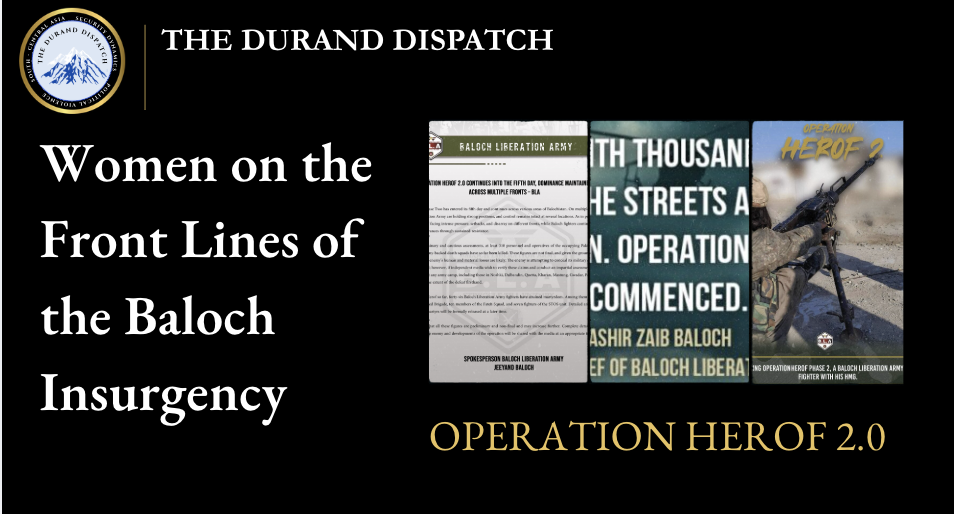
Operation Herof 2.0: Women on the Front Lines of the Baloch Insurgency

In the early hours of January 30, 2026, the Baloch Liberation Army (BLA) launched what it termed “Operation Herof 2.0”—a six-day, multi-district offensive that would become one of the most extensive militant operations in Balochistan’s history. Striking across multiple areas in about 12 districts, the BLA coordinated assaults on security installations, police stations, banks, and government buildings from Quetta to Gwadar. 

A Doctrine of Escalation

Operation Herof 2.0 followed the original Operation Herofexecuted in August 2024, which the BLA itself described as a turning point in its campaign. The February 2026 sequel marked a dramatic escalation in both scale and sophistication: The BLA claimed over 70 attacks in 14 cities, killing 300+ security forces personnel, with all of its combat units reportedly engaged: the Majeed Brigade (suicide operations), Fateh Squad, Special Tactical Operations Squad (STOS), ZIRAB (intelligence wing), and Hakkal (media wing). Pakistan’s security forces responded with counter-operation “Radd-ul-Fitna 1,” which the ISPR reported resulted in the deaths of 200 + militants. 

The Durand Dispatch April/May 2025 perspectives issue documents early glorification of Majeed Brigade suicide bombers and tribute campaigns for female operatives in Operation Herof 1.0, while the October 2025 Strategic Messaging issue highlights the “Doctrine of Last Bullet” philosophy emerging within BLA’s propaganda.

From Remote Insurgency to Urban Warfare

What distinguishes the current phase of the Baloch insurgency from its predecessors is its rapid urbanization. Once dismissed as a limited insurgency confined to remote terrains, the BLA’s operational footprint has extended into urban centres, drawing educated professionals and university graduates into its ranks. Recent BLA propaganda posters have featured militants such as Qadir Kashani from UMT Lahore, Salim Baloch from Punjab University, and Abubakar Baloch from Iqra University Karachi—individuals whose backgrounds challenge the traditional profile of rural insurgent fighters. The formation of the BLA’s QAHR (Qazi Aero Hive Rangers) air and drone warfare unit, which claimed strikes on strategic assets including Gwadar port, signals a further technological evolution. 

Women in Combat

Perhaps the most striking dimension of the BLA’s evolution is the growing role of women in combat operations, including within the Majeed Brigade’s suicide squads. Recent BLA propaganda depicts young women and middle-aged women training alongside male counterparts, joining various combat units, and securing formal family consent before deployment. The case of Hawaa Baloch (nom de guerre: Droshum) illustrates this trajectory: a formally educated Gen Z woman whose father was reportedly killed by security forces in 2021– she was featured in BLA footage alongside her mother, pledging her life to the cause before dying in Operation Herof 2.0. Various reports state that in an operation that killed 18 BLA fighters, about 11 were “fidayeen” (suicide attackers), among whom at least some were women. This, along with  figures such as Durjan Baloch of the Fateh Squad and propaganda portraying couples and mothers fighting alongside their sons, suggests an insurgency embedded within family structures.

This gendered dimension is not unique to the Baloch insurgency. As our March edition details, the TTP and Islamic State have also intensified efforts to recruit women—through magazines like Khateja tul Kubra and dedicated sections in the new Islamic State Invade magazine (technically issued under the IS-Pakistan label). However, the BLA’s integration of women into front-line combat roles, including suicide operations, represents a qualitative shift in the regional militant landscape that demands close monitoring. 

The Durand Dispatch’s September 2025 issue notes the BLA’s expanding political messaging toward women, while also analyzing the TTP’s gender-specific propaganda strategy across its Mujalla Banat series.

Implications

The BLA’s trajectory raises several urgent questions for Pakistan’s security establishment. The international condemnation of BLA attacks by China, France, Turkey, and the United States underscores the diplomatic stakes, particularly given Balochistan’s centrality to the China-Pakistan Economic Corridor, and a place of growing interest to the US for critical minerals. The BLA’s prisoner-swap ultimatum—releasing 10 of 17 detained soldiers while demanding Baloch prisoners in return—signals a group that perceives itself as negotiating from a position of strength. 

Taken together, Operation Herof 2.0 reveals an insurgency that is rapidly evolving its strategies and tactics. The BLA's ability to coordinate across a dozen districts while the military was simultaneously engaged against the TTP in the northwest exposed critical force-distribution vulnerabilities. Its recruitment of university-educated urbanites, deployment of drone units, and—most importantly—integration of women into front-line and suicide roles collectively signal an organisation that is broadening its social base, not contracting. For Islamabad, the strategic question is no longer whether the Baloch insurgency can be contained at the periphery. 

For a full analysis of the BLA’s operational evolution, propaganda apparatus, and its implications alongside other militant groups operating in Pakistan, see the Durand Dispatch March 2026 Strategic Messaging edition and prior issues.For detailed analysis of ISKP’s recent propaganda output, attack claims, see our Strategic Messaging issues:

Reply

Avatar

or to participate

Keep Reading